
Disclosure: some links on this page are affiliate links. If you sign up through them, we may earn a commission at no extra cost to you. This doesn’t change how we evaluate products. Pricing and features are as of October 2026 and come from HighLevel’s official pricing page; check the live page before you buy.
Quick Verdict
HighLevel (often called GoHighLevel) is one of the strongest all-in-one options for marketing agencies that manage several clients. It bundles a CRM, pipelines, funnel and website builder, email and SMS marketing, booking calendars, workflow automation and reputation management under one login, with unlimited contacts and unlimited users on every plan. The trade-offs are a real learning curve and usage-based fees for phone, SMS, email and AI on top of the subscription.
- Best for: agencies with multiple clients, and agencies planning to resell software under their own brand
- Not ideal for: solo users who only need a simple contact list or a basic email newsletter tool
- Price (as of October 2026): from $97/month, or $970/year on the Starter plan
- Free trial: 14 days, and billing starts automatically when it ends unless you cancel
Most marketing agencies run on a patchwork of tools: one app for the CRM, another for landing pages, a third for email, a fourth for SMS, a scheduling tool, a review-request tool and a handful of Zapier connections holding it all together. Every new client adds another set of logins and another line on the software bill.
HighLevel is built to replace that stack. In this review we break down what the platform includes, what each plan costs as of October 2026, where it shines, where it falls short and how it compares with HubSpot, Keap and ActiveCampaign. We base it on HighLevel’s published plans and feature list rather than marketing hype, and we flag the costs that aren’t obvious from the headline price.
What Is HighLevel?
HighLevel is an all-in-one sales and marketing platform designed mainly for agencies. It’s based in Dallas, Texas. Its core idea is the sub-account: you run an agency-level account, and each client (or each business you own) gets its own sub-account with its own contacts, pipelines, funnels, calendars and automations. You see everything from one dashboard, and you can white-label the desktop web app so clients see your logo instead of HighLevel’s.
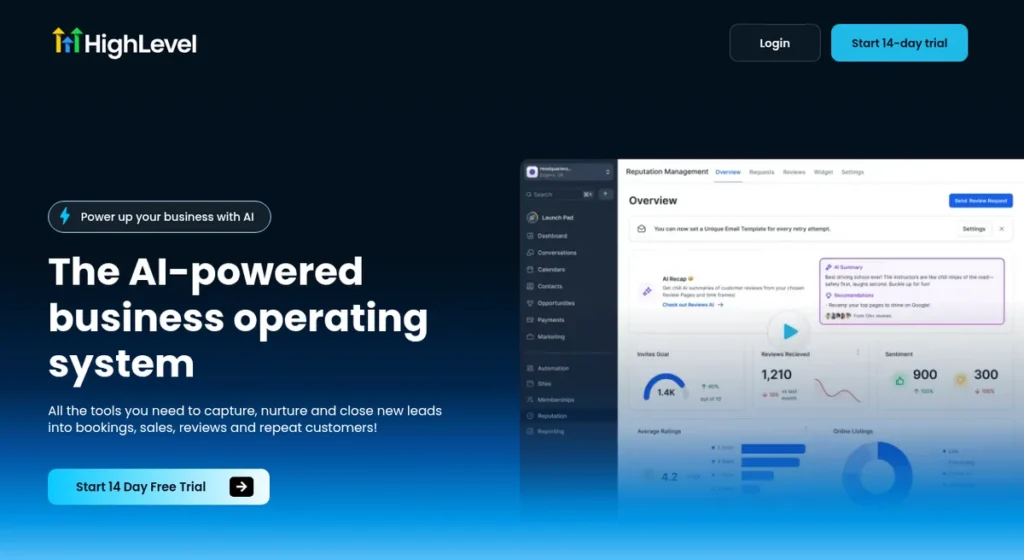
HighLevel says most users replace their CRM, funnel builder, email marketing software, appointment scheduler, SMS marketing tool and review management software with it. Whether that’s true for you depends on how deep your current tools go, but the breadth of the feature list is real.
Key Features
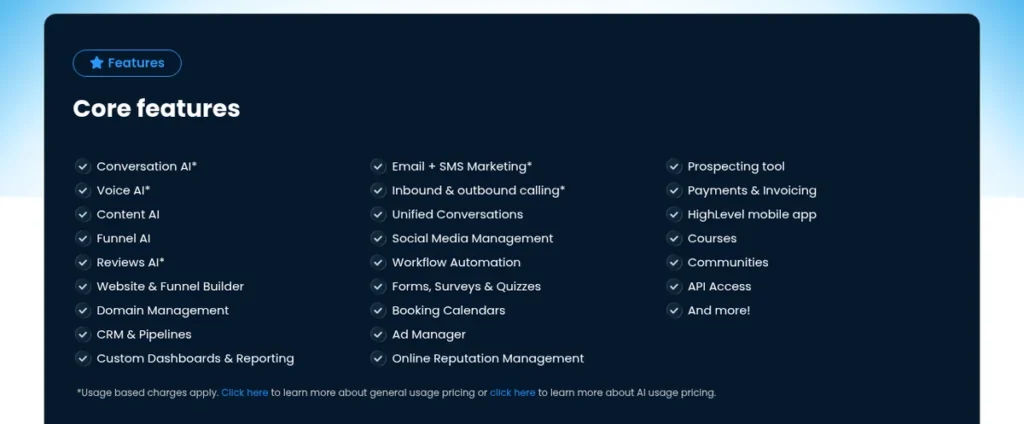
HighLevel’s pricing page lists these core features on its plans (as of October 2026):
CRM, Pipelines and Reporting
You get a contact CRM with sales pipelines, custom dashboards and reporting. Contacts and users are unlimited on every plan, which matters for agencies: you aren’t penalized for adding a client’s sales team or importing a large list. The Pro plan adds user and agent reporting.
Website and Funnel Builder
A drag-and-drop website and funnel builder with domain management lets you build landing pages, opt-in funnels and full sites, and connect custom domains for each. Forms, surveys and quizzes plug straight into the CRM. If you currently pay for a separate funnel builder, this is often the first tool agencies drop.
Email, SMS and Unified Conversations
Email and SMS marketing, inbound and outbound calling, and a unified conversations inbox put client messages from different channels in one place. HighLevel also lists WhatsApp as an optional add-on. Note that email, SMS and calling are usage-based: you pay for messages, minutes and phone numbers on top of the plan.
Workflow Automation
The workflow builder handles the follow-up logic agencies usually stitch together with third-party tools: lead comes in, gets tagged, receives an email and text, books on a calendar, gets a reminder, then gets a review request after the appointment. If you’re comparing it with general-purpose tools, see our guide to Zapier, Make, n8n and Activepieces. HighLevel’s automations are built around marketing and sales, while those tools connect almost any app.
AI Tools
HighLevel lists Conversation AI, Voice AI, Content AI, Funnel AI and Reviews AI. Several of these carry usage-based charges, and HighLevel sells “AI Employee” plans as add-ons (details in the pricing section). HighLevel’s own disclaimer notes that AI features need setup, configuration and ongoing human oversight, which is a fair way to think about them.
Everything Else
- Booking calendars
- Social media management and an ad manager
- Online reputation management
- A prospecting tool
- Payments and invoicing (Stripe, PayPal, NMI, Authorize.net, Square, Adyen, Razorpay and others)
- Courses and communities
- The HighLevel mobile app
- API access (basic on Unlimited, advanced on Pro)
HighLevel also offers “Snapshots”, a library of pre-built account setups for industries such as real estate, dentists and gyms. You load one into a new sub-account instead of building every funnel and workflow from scratch.
HighLevel Pricing (as of October 2026)
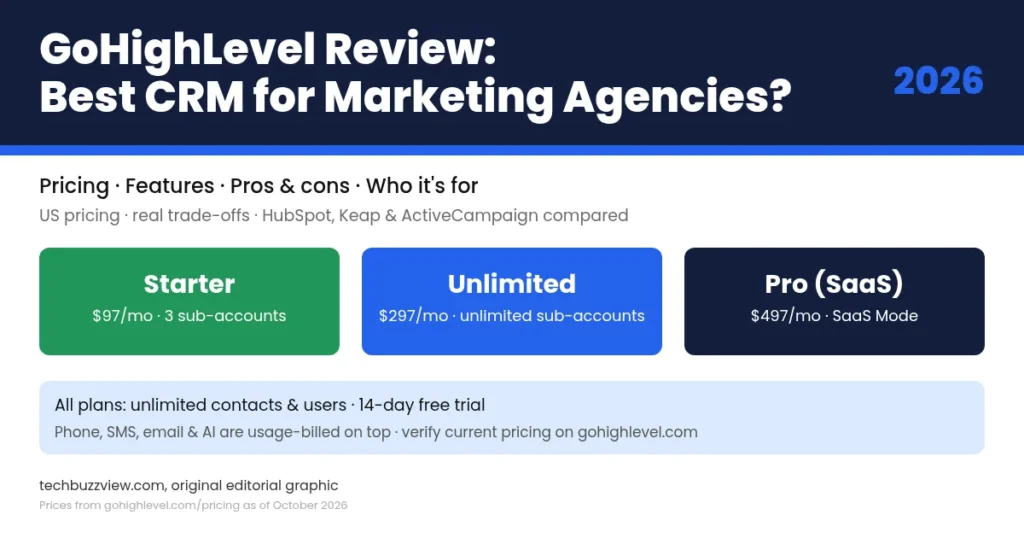
HighLevel has three self-serve plans plus a custom Enterprise plan. Every self-serve plan includes unlimited contacts and unlimited users, and comes with a 14-day free trial.
| Plan | Monthly | Annual | Sub-accounts | What’s added |
|---|---|---|---|---|
| Starter | $97/mo | $970/yr | 3 | Unlimited contacts and users, core features, 24/7 support |
| Unlimited | $297/mo | $2,970/yr | Unlimited | Everything in Starter, plus rebilling for phone and email (no markup) and basic API access |
| Pro (SaaS) | $497/mo | $4,970/yr | Unlimited | Everything in Unlimited, plus SaaS Mode, automated sub-account creation, rebilling with markup, user/agent reporting and advanced API access |
| Enterprise | Custom quote | Unlimited | Dedicated success and account managers, premium support, quarterly business reviews, enterprise reporting, white-label mobile app and HIPAA compliance included | |
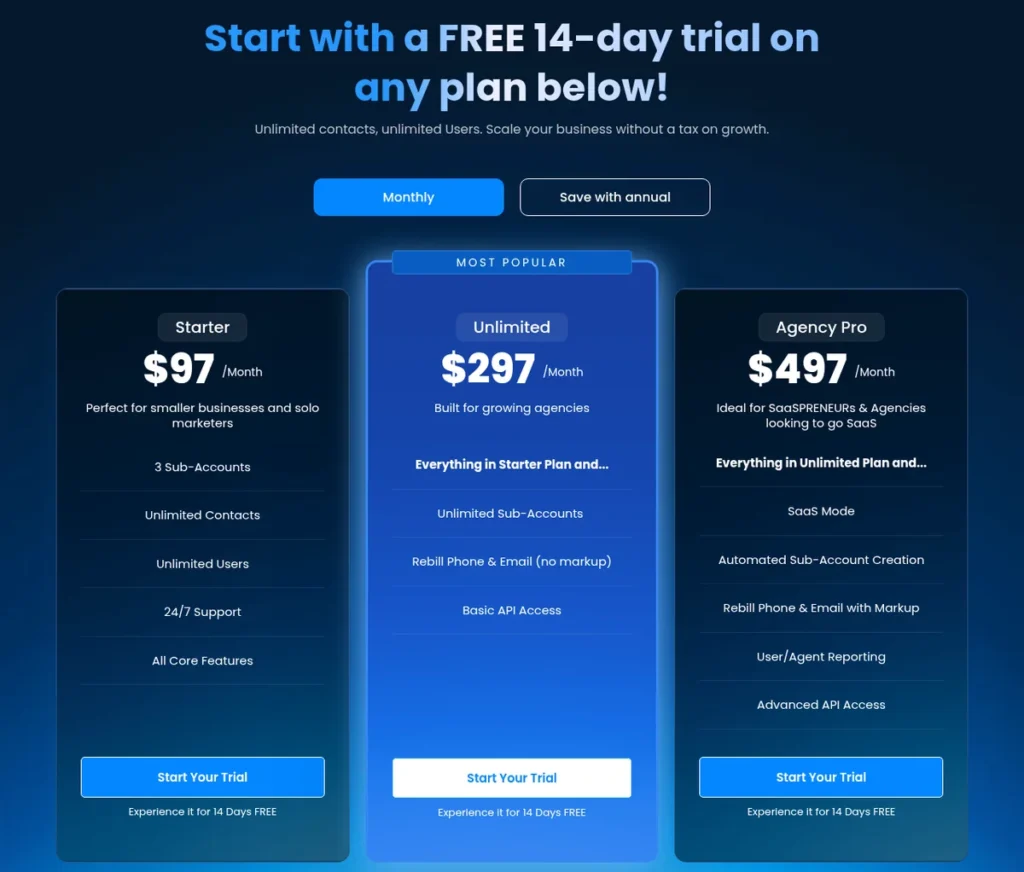
Monthly or annual? On Starter, twelve monthly payments of $97 come to $1,164, against $970 for annual billing. The same pattern holds on Unlimited ($3,564 vs. $2,970) and Pro ($5,964 vs. $4,970). If you already know you’ll stay for a year, annual billing on Starter or Unlimited costs less. If you’re still evaluating, start with the trial.
Costs on Top of the Plan
This is the part many reviews skip. HighLevel states that subscriptions cover platform features, but phone numbers, SMS, emails sent and premium AI usage are charged by usage. Usage fees can also apply during the free trial. On the Unlimited and Pro plans you can rebill those costs to clients, and Pro lets you add a markup.
Optional add-ons listed as of October 2026 include:
| Add-on | Listed price |
|---|---|
| AI Employee Growth Plan | $50/month per sub-account |
| AI Employee Unlimited Plan | $97/month per sub-account |
| Branded Client Portal App | $49/month per sub-account |
| Dedicated email IP | $59/month per IP |
| SEO (powered by Search Atlas) | $79/month per sub-account |
| HIPAA compliance | $297/month |
| White-label mobile app | $497/month |
| WordPress hosting | From $10/month per site |
| HighLevel Certification Program | $97/month |
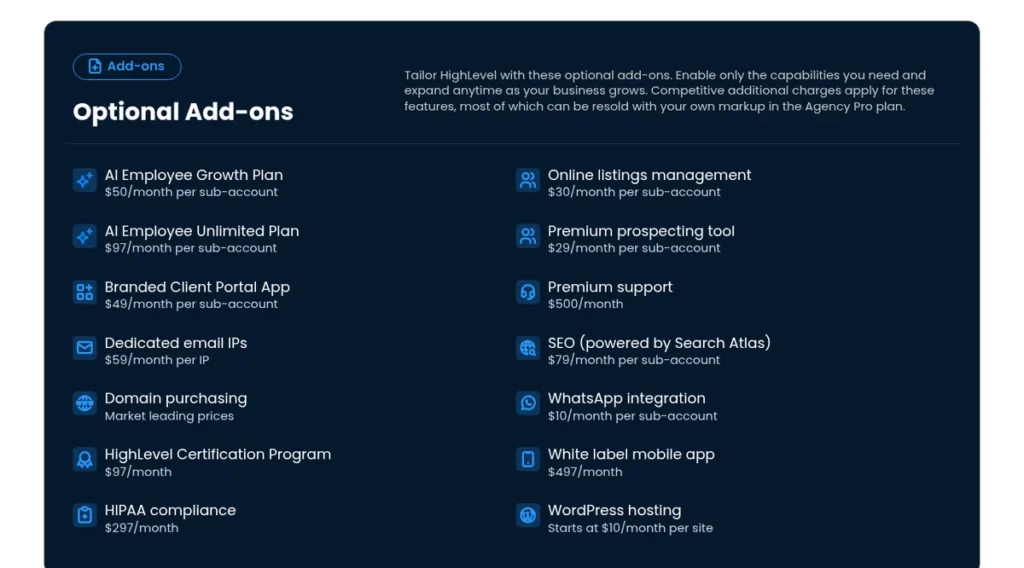
Budget for usage on top of the subscription, especially if your clients rely heavily on SMS or calling.
Which HighLevel Plan Should You Pick?
- Starter ($97/mo): a single business owner, or a new agency with up to three clients. You get the full core feature set; the main limit is three sub-accounts.
- Unlimited ($297/mo): an agency that’s adding clients. Unlimited sub-accounts mean your software cost doesn’t rise with each new client, and you can rebill phone and email usage at cost.
- Pro ($497/mo): an agency that wants to sell HighLevel as its own branded software. SaaS Mode lets clients sign up and pay on your website, and their accounts are created automatically. You can rebill usage with a markup.
You can upgrade mid-month and pay only the prorated difference, and you can downgrade later. Because Pro includes everything, trialing it first shows you the full platform before you settle on a plan.
Pros and Cons
Pros
- Replaces several separate tools (CRM, funnels, email, SMS, calendars, reviews) with one platform
- Unlimited contacts and users on every plan
- Unlimited sub-accounts from the Unlimited plan up, so client growth doesn’t raise your software bill
- White-label desktop app and custom domains
- SaaS Mode on Pro for agencies that want to resell software
- Snapshots speed up new client setup
- Annual billing costs less than paying monthly for 12 months
Cons
- Usage-based fees for phone, SMS, email and AI add to the headline price
- Several useful extras (AI Employee, white-label mobile app, HIPAA) are paid add-ons
- The breadth of features means a real learning curve
- Starter’s three-sub-account limit is tight for a growing agency
- Overkill if you only need a simple CRM or email tool
- No free plan is listed on the pricing page, only a 14-day trial that bills automatically unless you cancel
Who HighLevel Is For (and Who Should Skip It)
A good fit if you are:
- A marketing or lead-generation agency managing several local-business or service clients
- An agency paying for separate CRM, funnel, email, SMS and scheduling tools and wanting to consolidate
- A consultant who wants to offer clients a branded CRM and automation platform
- A service business (clinics, home services, coaches, real estate teams) that books appointments and follows up by text and email
Probably not a fit if you are:
- A solo creator who just needs a newsletter tool
- A large B2B sales team that needs deep enterprise sales forecasting and a huge native integration marketplace
- Someone who wants a tool that works with zero setup; HighLevel rewards the time you put into configuring it
HighLevel vs. HubSpot vs. Keap vs. ActiveCampaign
All four tools handle contacts and marketing automation, but they’re built for different buyers. Competitor pricing changes often and varies by seat and contact count, so check each vendor’s current pricing page before comparing costs.
| Tool | Built mainly for | Where it fits best |
|---|---|---|
| HighLevel | Agencies managing many clients | All-in-one CRM, funnels, SMS/email and automation, with sub-accounts and white-labeling |
| HubSpot | Companies running their own sales and marketing | In-house teams that want a widely used CRM with separate marketing, sales and service products |
| Keap | Small businesses | Small service businesses that want CRM plus sales and marketing automation for one company |
| ActiveCampaign | Email-led marketers | Businesses whose main need is email marketing automation and segmentation |
The short version: if you run your own company’s marketing, HubSpot, Keap or ActiveCampaign may be the more natural fit. If you run marketing for many clients and want one platform, one bill and your own branding, HighLevel’s sub-account model is what sets it apart. If you’re still at the free-tool stage, our roundup of free CRM tools is a better starting point.
How to Get Started Without Wasting the Trial
- Pick one real client or offer to test. Don’t try to migrate your whole agency in 14 days.
- Load a Snapshot for that industry if one exists, then customize the funnel, calendar and follow-up workflow.
- Connect your domain and email sending. Make sure your domain’s SPF, DKIM and DMARC records are set up; our business email setup guide explains each record.
- Watch your usage charges for SMS, calls and AI during the trial so you know what a real month would cost.
- Set a calendar reminder before day 14 to decide whether to keep, downgrade or cancel, since billing starts automatically.
If you also build client sites outside HighLevel, see our comparison of the best web hosting for small business. For the SEO side of client work, see the best AI SEO tools for US businesses.
Frequently Asked Questions
How much does GoHighLevel cost in 2026?
As of October 2026, Starter is $97/month ($970/year), Unlimited is $297/month ($2,970/year) and Pro is $497/month ($4,970/year). Enterprise is custom-priced. Usage-based charges for phone, SMS, email and AI are extra.
Does HighLevel have a free trial?
Yes. Each self-serve plan offers a 14-day free trial. Billing begins automatically at the end of the trial unless you cancel, and usage-based fees may apply during the trial.
What’s the difference between the Starter and Unlimited plans?
Mainly sub-accounts. Starter includes three; Unlimited includes unlimited sub-accounts, plus phone and email rebilling at cost and basic API access.
What is SaaS Mode?
SaaS Mode, available on the Pro plan, lets you sell HighLevel subscriptions under your own brand. Clients sign up on your website and their accounts are created automatically. You set the price and can rebill usage with a markup.
Can I white-label HighLevel?
Yes. You can white-label the desktop web app and connect custom domains for funnels and websites. A white-label mobile app is a $497/month add-on, and it’s included with Enterprise.
Is HighLevel better than HubSpot?
It depends on who you are. HighLevel is built for agencies running many client accounts under one roof. HubSpot is a common choice for companies managing their own sales and marketing in-house.
Can I switch plans later?
Yes. You can upgrade at any time and pay the prorated difference mid-month, and you can downgrade if your needs change.
Final Verdict
For marketing agencies juggling several clients and a stack of disconnected tools, HighLevel is one of the most complete platforms available. It covers CRM, funnels, messaging, booking, automation and reputation management, and the Unlimited and Pro plans let you add clients without adding software costs. Go in with realistic expectations: budget for usage fees, plan time to learn the system, and use the trial on a real client workflow.
If that sounds like your agency, the Pro trial is the easiest way to see every feature, including SaaS Mode, before you commit. If you’d rather start smaller, you can explore HighLevel’s plans here.
Pricing, plan features and add-ons are as listed on gohighlevel.com in October 2026 and may change. HighLevel’s own terms note that results vary, and nothing here is a promise of earnings, savings or business results.