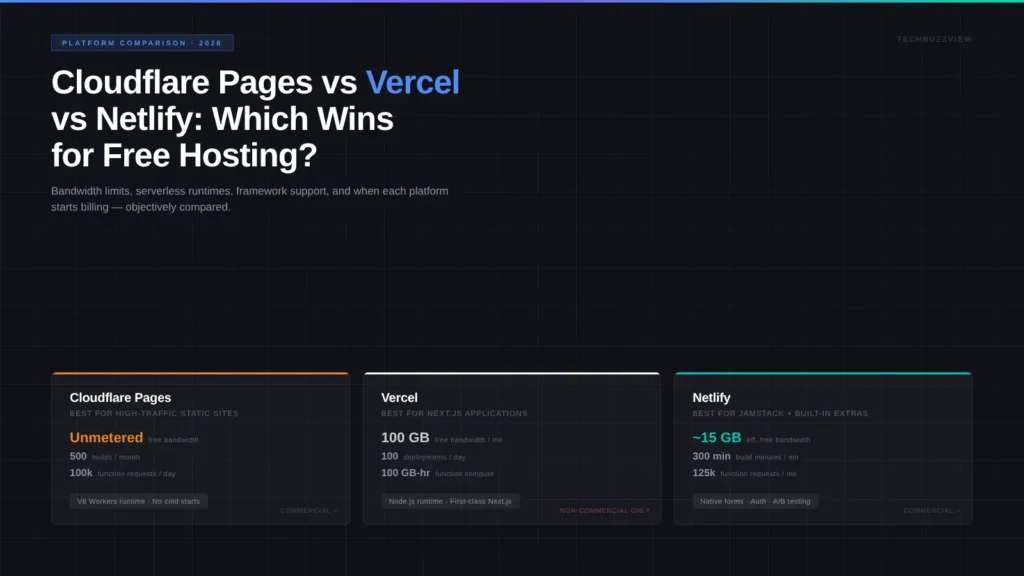
You have three solid free tiers for hosting a static site or JAMstack app — Cloudflare Pages, Vercel, and Netlify. For a side project, portfolio, or small team, all three work. But they make different trade-offs, and picking the wrong one creates real friction later when you hit a bandwidth ceiling, need to add a backend function, or want to deploy a Next.js app without a surprise bill.
This comparison covers what actually differs between them in 2026: free tier limits, performance, framework support, serverless functions, and when each one starts costing money.
Quick Summary: Who Should Use Which
| Platform | Best For | Free Tier Bandwidth | Paid Tier Starts At |
|---|---|---|---|
| Cloudflare Pages | High-traffic static sites, bandwidth-conscious projects | Unmetered (static assets) | $5/month (Workers Paid) |
| Vercel | Next.js apps, React projects, developer DX | 100 GB/month (non-commercial only) | $20/user/month (Pro) |
| Netlify | Astro, Hugo, Gatsby, sites needing built-in extras (forms, auth) | ~15–30 GB/month via credit system | $9/user/month (Pro) |
Caveat on pricing: All three platforms update their pricing frequently. The figures above come from third-party comparisons current to mid-2026. Verify on each vendor’s pricing page before making a decision that depends on specific numbers.
Cloudflare Pages
What it is
Cloudflare Pages deploys static sites directly to Cloudflare’s global edge network. Assets are served from data centers closest to your visitors with no bandwidth charge — that’s the defining advantage of the free tier.
Free tier highlights
- Unmetered bandwidth for static assets
- 500 builds per month
- Unlimited sites and projects
- Pages Functions on the Workers free tier: 100,000 requests per day
- Preview deployments for every branch and PR
Performance
Because Cloudflare operates its own CDN with 300+ data centers globally, static asset delivery is genuinely fast from most locations. For US traffic specifically, Time to First Byte (TTFB) for static assets is competitive with Vercel’s edge network.
Framework support
Cloudflare Pages works well with any framework that outputs static HTML — Astro, Gatsby, Hugo, Jekyll, Eleventy, and SvelteKit in static mode all deploy without configuration. Next.js support is available through the @cloudflare/next-on-pages adapter, but it has limitations versus native Vercel deployment, particularly around ISR (Incremental Static Regeneration) and some middleware patterns.
Serverless functions
Pages Functions uses Cloudflare Workers under the hood — V8 isolates rather than Node.js containers. They start in under a millisecond with no cold start. The trade-off: the Workers runtime is not Node.js, so npm packages that rely on Node.js globals or native modules won’t work. Code targeting the Workers runtime requires awareness of these constraints.
One thing to watch
Cloudflare has been gradually steering developers from Pages toward using Workers with static assets directly. The products overlap, and while Pages isn’t going away, this product direction shift is worth keeping in mind if you’re building something long-term on the Pages-specific workflow.
Best for
Projects that need bandwidth generosity: documentation sites, marketing pages, content-heavy portfolios, and any project where you expect traffic spikes but want to avoid bandwidth bills.
Vercel
What it is
Vercel is the company that created Next.js, and it remains the best deployment target for Next.js applications. It’s built around the concept of deploying frontend frameworks with zero configuration — connect a GitHub repo and Vercel detects the framework, sets build commands, and deploys.
Free tier highlights
- 100 GB bandwidth/month (Hobby tier — non-commercial use only)
- 100 deployments per day
- Serverless Functions: 100 GB-hours of compute
- Edge Functions (globally distributed): unlimited invocations on Hobby
- Preview deployments per branch
- Vercel Analytics (limited data retention)
Non-commercial restriction
The Hobby tier’s terms explicitly restrict commercial use. If you’re building a product, a client site, or anything that generates revenue, you need the Pro plan at $20/user/month. This is a real constraint that catches developers who build side projects on Hobby and then commercialize them.
Framework support
Vercel has first-class support for Next.js — App Router, Pages Router, ISR, Server Components, Partial Prerendering, and middleware all work exactly as documented. SvelteKit, Nuxt, Astro, Remix, and Gatsby are also supported with solid adapters. For anything involving React Server Components and edge rendering at scale, Vercel is the smoothest experience available.
Serverless functions
Vercel Functions run in Node.js (or Edge runtime when specified). Cold starts exist but are typically short — under 200ms for lightweight functions. The Node.js runtime means the full npm ecosystem works without compatibility concerns. At scale, function compute costs are where Vercel bills can grow unexpectedly; the Hobby tier’s compute allowance is generous for low-traffic projects but limited for apps with server-side logic.
Developer experience
Vercel’s DX is widely considered the best in the category: instant preview deployments with comment-on-preview collaboration, the vercel dev CLI that mirrors the production environment locally, and tight GitHub/GitLab/Bitbucket integration. Deployments typically complete in 30–90 seconds for a medium Next.js app.
Best for
Next.js applications, teams that value a polished DX and preview-per-PR workflow, and projects where React Server Components or ISR are central to the architecture.
Netlify
What it is
Netlify was the original JAMstack platform and still has the broadest built-in feature set: forms, identity (auth), A/B split testing, branch deploys, and a plugin ecosystem that extends the build pipeline. It has evolved toward a more general platform play while remaining excellent for static-heavy sites.
Free tier in 2026
In April 2026, Netlify restructured its free tier around a credit system. The Starter plan includes 300 credits per month, with bandwidth charged at 20 credits per GB. This works out to approximately 15 GB of effective free bandwidth — significantly less than Cloudflare Pages (unmetered) or Vercel (100 GB). For low-traffic projects, 15 GB is plenty. For sites expecting meaningful traffic, this is a constraint to plan for.
- ~15–30 GB bandwidth equivalent (via 300-credit system)
- Build minutes: 300 minutes/month
- Serverless Functions: 125,000 requests/month, 100 hours compute
- Forms: 100 submissions/month
- Identity (auth): 1,000 active users
Framework support
Netlify supports virtually every static site generator and JAMstack framework. Its Astro support is particularly strong — the Netlify adapter for Astro handles SSR, image optimization, and edge functions cleanly. Hugo, Jekyll, Eleventy, Gatsby, and SvelteKit all deploy well. Next.js works via the @netlify/plugin-nextjs adapter with good coverage of App Router features.
Serverless functions
Netlify Functions run on AWS Lambda in the background — standard Node.js runtime with cold starts. Netlify Edge Functions run on Deno Deploy at the edge, which is a different runtime than Workers. For most use cases, the Node.js functions work exactly as expected. The edge functions require Deno-compatible code, which is a smaller consideration than Cloudflare’s Workers constraints but worth noting.
Built-in extras
The native form handling (no JavaScript required, just add netlify attribute to your HTML form) is genuinely useful for contact forms on static sites. The built-in identity system and A/B split testing remove the need for third-party services on simple projects. These differentiate Netlify from the other two for non-developer site owners or small teams without dedicated backend resources.
Best for
Astro sites, projects that use static forms, JAMstack projects that need built-in auth, and developers who want the broadest ecosystem of build plugins. Also the most accessible entry paid tier at $9/month if you need to go commercial.
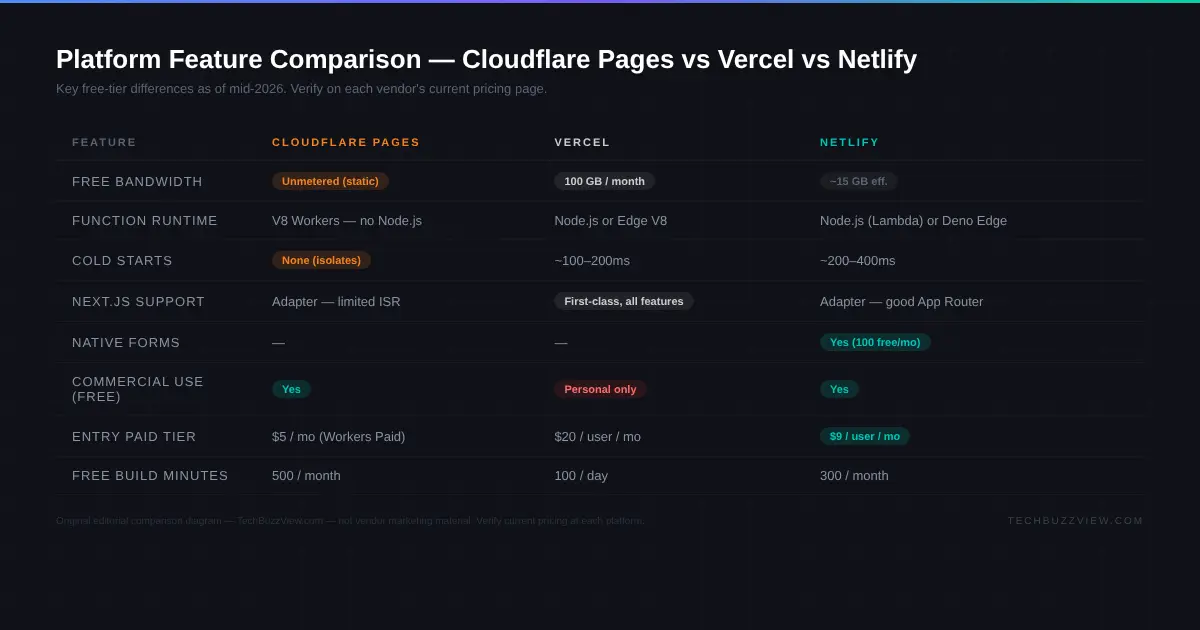
Side-by-Side: Key Technical Differences
| Feature | Cloudflare Pages | Vercel | Netlify |
|---|---|---|---|
| Free bandwidth | Unmetered (static) | 100 GB (non-commercial) | ~15–30 GB (credit system) |
| Function runtime | V8 Workers (no Node.js) | Node.js or Edge (V8) | Node.js or Deno Edge |
| Cold starts | None (isolates) | ~100–200ms | ~200–400ms (Lambda) |
| Next.js support | Adapter, limited ISR | First-class, full feature | Adapter, good App Router |
| Build minutes (free) | 500/month | 100/day | 300/month |
| Forms (native) | No | No | Yes (100 subs/month) |
| Commercial use (free) | Yes | No (Hobby = personal only) | Yes |
| Entry paid tier | $5/mo (Workers) | $20/user/mo | $9/user/mo |
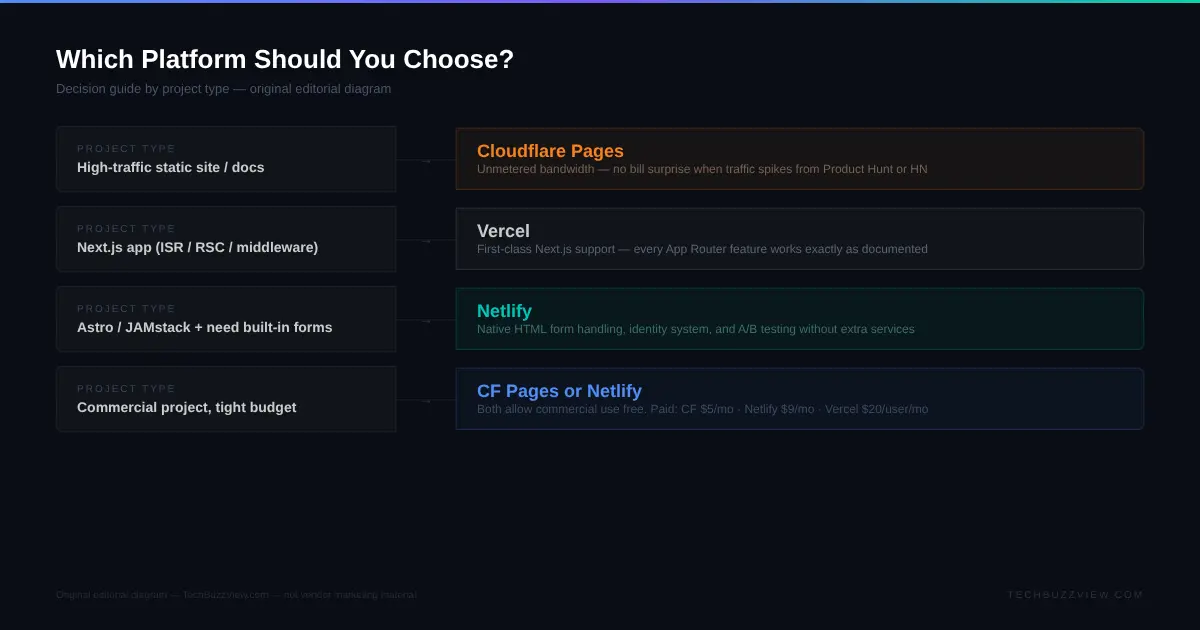
Common Use Cases and the Right Match
A portfolio or personal blog
All three work for free. Cloudflare Pages is the safest choice if you want no bandwidth surprise as your posts gain traction. Vercel is fine for Hobby use (personal, non-commercial). Netlify is straightforward if you use a framework with a solid Netlify adapter.
A startup marketing site
Cloudflare Pages or Netlify — both allow commercial use on the free tier. Cloudflare’s unmetered bandwidth handles traffic spikes from a product launch without a bill. Netlify’s entry paid tier at $9/month is accessible if you need native forms or the platform grows.
A Next.js web app
Vercel. Every Next.js feature works as documented, there’s no adapter complexity, and the DX is optimized specifically for this use case. If commercial use applies, budget for the $20/user/month Pro plan.
An Astro site with SSR
Netlify or Cloudflare Pages. Netlify’s Astro adapter is mature and well-maintained. Cloudflare’s Workers runtime requires the Cloudflare Astro adapter, which works well but is less tolerant of Node.js-dependent packages.
A documentation site expecting significant traffic
Cloudflare Pages. The unmetered static bandwidth means a traffic spike from a Product Hunt launch or a Hacker News post costs you nothing additional.
What Doesn’t Differentiate Them
For pure static sites — no server-side logic, no dynamic functions — all three platforms deliver fast, reliable hosting with a CI/CD pipeline connected to your git repository. The “winner” for a plain HTML/CSS/JS site is whichever one you have a team preference for. Performance differences at the edge are small enough that framework fit, team familiarity, and your path to paid tier matter more than raw benchmark numbers.
Verify Before You Commit
Cloudflare Pages is steering toward Workers as its primary surface. Netlify updated its free tier pricing in April 2026. Vercel’s non-commercial restriction has been enforced more actively as the platform scales. These details matter for long-term project planning. Check each platform’s official pricing and terms before building something that depends on specific free tier limits.
Frequently Asked Questions
Is Cloudflare Pages truly free with unlimited bandwidth?
The free tier offers unmetered bandwidth for static assets served from the CDN. Dynamic requests through Pages Functions are subject to the Workers free tier limits (100,000 requests/day). Bandwidth for function responses is metered separately. For sites that are primarily static, it’s effectively unlimited for most real-world traffic levels.
Can I use Vercel for a commercial project on the free tier?
No. Vercel’s Hobby tier explicitly restricts usage to personal non-commercial projects. A client site, a SaaS product, or anything generating revenue requires the Pro plan at $20/user/month. This is a meaningful distinction versus Cloudflare Pages and Netlify, which permit commercial use on their free tiers.
How does Netlify’s 2026 credit system work?
Netlify’s Starter plan includes 300 credits per month. Bandwidth costs 20 credits per GB. That gives you roughly 15 GB of effective free bandwidth. Other usage (build minutes, function invocations) also draws from the same credit pool. When credits run out, Netlify either limits service or charges for overages depending on your plan configuration.
Which platform has the fastest global performance?
For pure static assets, Cloudflare Pages has the edge (literally) — Cloudflare’s CDN has more globally distributed points of presence than Vercel’s or Netlify’s networks. For dynamic, server-rendered responses, the comparison depends heavily on where your users are and which regions each platform’s edge functions run in. For US-focused projects, differences are small enough to be secondary to framework fit and DX preferences.